
What a complete weep hole filter specification should contain, from flow rate and soil retention to material grade and maintainability, so the product you spec performs the way your design assumes.
A weep hole filter is a small line item, but it controls whether a retaining wall, seawall, abutment, or culvert sheds water for decades or fails when its drains clog. A good specification removes ambiguity: it states the required flow rate and the conditions it was measured under, the soil retention the filter must provide, the material grade for the environment, and whether the unit can be maintained without excavation. This guide covers each of those requirements and how to write them so the installed product matches your design intent.
What a Weep Hole Filter Spec Must Cover
Five requirements separate a defensible specification from a vague one. Each should be stated with the standard or test condition that backs it, so a reviewer can verify the product rather than take a datasheet at face value.
The Five Spec Requirements
Flow rate with stated test conditions. Pressure (PSI) and soil condition must accompany any flow number.
Geotextile soil retention (ASTM D4751). The apparent opening size must suit the retained soil gradation.
Material grade for the environment. 316L stainless steel for marine, coastal, and DOT work; ABS for protected freshwater.
Backflow control where required. Check valve (CVLV) models for tidal, flood, and submerged conditions.
Maintainability. The filter must be serviceable from the face of the wall without excavation or structural modification.
1. Specify Flow Rate With Its Conditions
A flow rate means nothing without the pressure and soil condition it was measured under. JET Filter™ performance was independently tested by TRI Environmental, Inc. (Report MAPP-LSH 2020-003). The numbers below are reported at 1 PSI with no soil resistance, the condition used for uniform comparison against traditional 2D weep holes of the same diameter.
| Model | Size | Flow Rate (1 PSI) | vs. Traditional | Maint. Interval |
|---|---|---|---|---|
| JF3SS | 3″ | 33 GPM | +35% | 3–5 Years |
| JF4SS | 4″ | 77.1 GPM | +92% | 4–7 Years |
| JF6SS | 6″ | 166.6 GPM | +87% | 6–10 Years |
Flow rates at 1 PSI, No Soil conditions per TRI Environmental Report MAPP-LSH 2020-003. Multiplier shows improvement over a standard 2D weep hole of the same diameter. Higher pressure differentials yield higher measured flow; see the reference guide for full multi-condition data.
Spec language tip: State the flow rate as a minimum at a defined pressure and soil condition, for example “minimum 77.1 GPM at 1 PSI, no soil resistance, per independent third-party testing.” This prevents substitution of a product whose flow was measured under more favorable conditions.
2. Specify Soil Retention, Not Just Drainage
A drain that passes water but also passes fines will undermine the structure it is meant to protect. The geotextile filter must retain the backfill soil while letting water through. Specify the geotextile against two standards: ASTM D4491 for water permeability and ASTM D4751 for apparent opening size (AOS). The AOS should be selected to match the gradation of the retained soil.
Because the JET Filter™ cartridge is replaceable, the geotextile can be inspected, cleaned, or renewed over the structure’s life rather than being buried and abandoned the way a one-time wrapped drain is.
3. Match Material to Environment
The housing material determines service life in the environment it sits in. Specify 316L stainless steel for marine, coastal, and DOT applications where corrosion resistance and a long maintenance-free housing life matter. The 316L housing carries a service life of 100+ years. Reference ASTM A240 and A666 for the stainless steel plate and strip. For protected freshwater applications where conditions are mild, the ABS plastic model is available.
4. Add Backflow Control Where Water Can Reverse
In tidal, flood, and submerged conditions, water can push back through a drain and carry sediment into the backfill. Check valve (CVLV) models add a one-way valve that lets the wall drain while resisting reverse flow. Specify a CVLV model wherever the hydraulic grade line can rise above the weep hole elevation, such as seawalls, bulkheads, and canal walls subject to high water.
5. Require Maintainability
University of Missouri research on maintainable drains identifies poor drainage as the most common cause of poor performance in earth retaining structures, with traditional weep holes clogging from backfill migration, vegetation, and wildlife or human activity. The defining feature of a maintainable drain is the ability to clean or replace the filter fabric from the face of the wall, which prevents the clog that ends a conventional drain’s service life. Specify that the filter cartridge and face plate be serviceable without excavation. The housing remains in place while the cartridge and face plate may be replaced over the housing’s lifespan.
Examples of Weep Hole Failure
These are the outcomes a good specification is written to prevent. When drainage clogs or was never filtered, trapped water builds hydrostatic pressure until the wall bows, cracks, or fails. Specify for flow, filtration, and maintainability up front and you avoid the repair.

How traditional weep holes clog and fail

Vinyl sheet piling wall failure
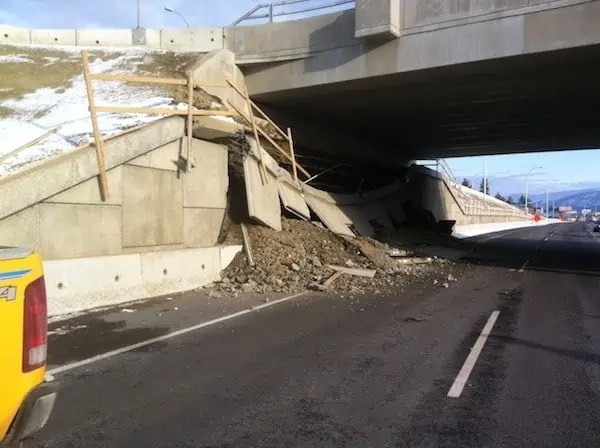
Retaining wall failure from trapped water
Standards to Reference in the Spec
| Standard | What It Tests | Applies To |
|---|---|---|
| ASTM A240 / A666 | Stainless steel plate, sheet, and strip specifications | 316L stainless steel housing (all SS and CVLV models) |
| ASTM D4491 | Water permeability of geotextiles | Replaceable geotextile filter cartridge |
| ASTM D4751 | Apparent opening size (AOS) of geotextile | Replaceable geotextile filter cartridge |
Steel standards apply to 316L stainless steel models only. Geotextile standards apply to the replaceable filter cartridge. Full test documentation is available through the Engineering Hub, or request information for spec support.
Specifying JET Filter™ on Your Next Project?
Product specs, CAD and STEP files, cut sheets, and compliance documentation are available through the Engineering Hub at no cost.
DOT Approved. Buy America compliant. US Patents #7,615,148 (open end) and #10,124,281 (check valve).